Reducing cigarette litter at transition points:
An Ordinance Development Tool
Reducing cigarette litter at transition points:
Cigarette butts are the most littered item in the U.S., making up 88% of all litter 4 inches or smaller—nearly 10 billion butts every day. Since 2002, Keep America Beautiful’s Cigarette Litter Prevention and Recycling (CLPR) Program has helped communities cut cigarette litter in half, with over 1,800 communities already seeing results.
Local businesses can make a difference! Follow the step-by-step guide below to draft ordinance language that engages businesses in reducing cigarette litter.
Introduction
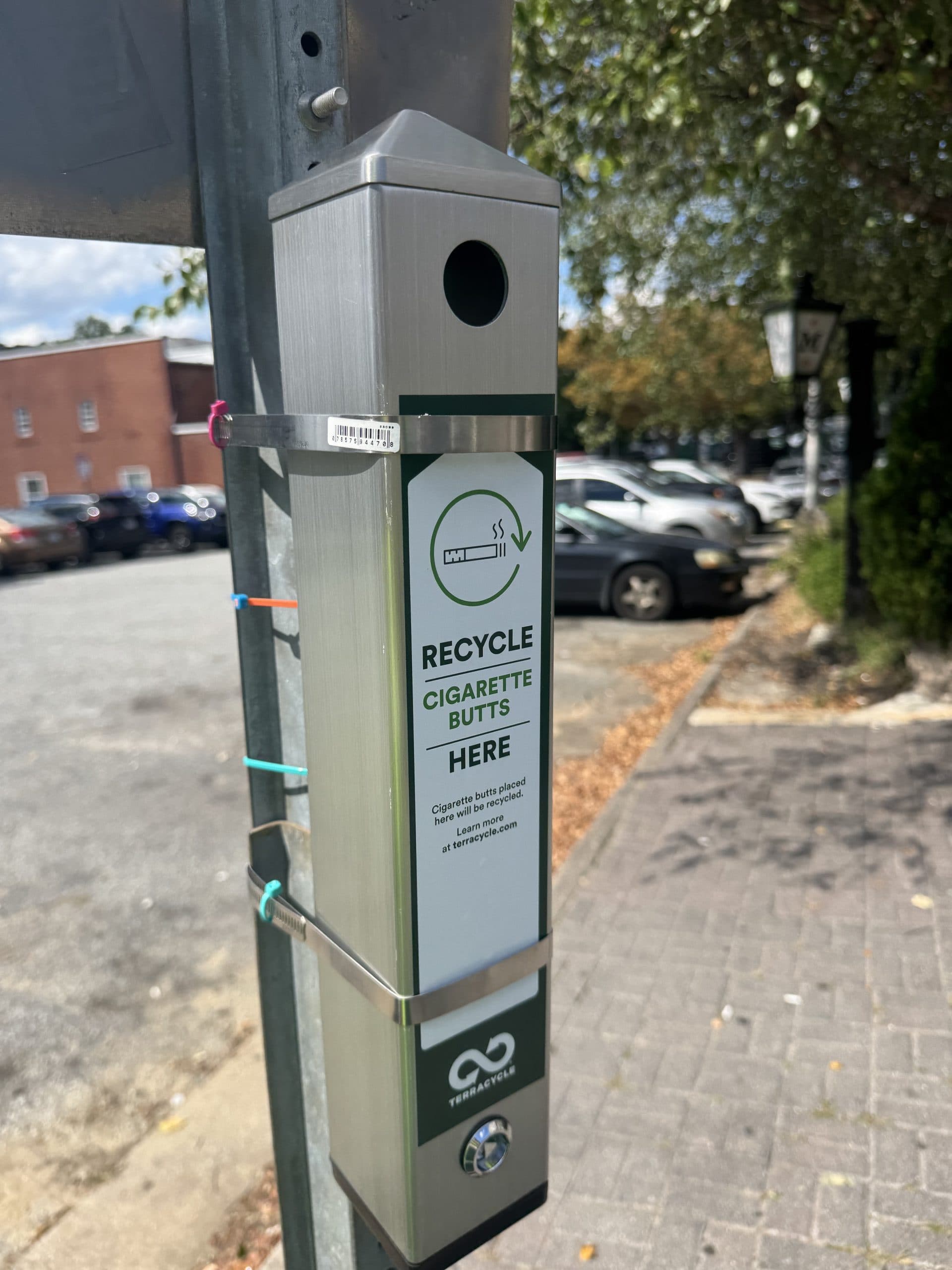
In 2020, Keep America Beautiful (KAB) conducted a study entitled “Smoking Bans and Cigarette Litter at Transition Points” to assess what factors influenced the amount of cigarette butt litter at transition points between smoking and “no smoking” areas (such as entrances into workplaces, restaurants and bars in some communities). [1] The findings indicated that regular removal of litter near transition points discouraged further littering of cigarette butts. So did the placement of receptacles specifically designed for cigarette butts. On the other hand, cigarette butt litter was more prevalent where property owners or occupants swept or blew litter off their property toward transition points, where physical “traps” like planted areas and gutters were present, and in those areas where infrastructure (i.e., curbs, sidewalks, planted areas) was degraded or damaged. These are factors that can be addressed by property owners and occupants.
Local governments can encourage property owners and occupants to take actions that abate cigarette butt litter through local ordinances. This tool presents potential approaches and examples of ordinance language to accomplish this.
[1] A. Goldsmith Resources, LLC. Smoking Bans and Cigarette Litter at Transition Points: A Report to Keep America Beautiful. December 2020.
How to use this tool
This tool can be used by local governments to develop language for an ordinance that enlists property owners’ and occupants’ assistance to abate cigarette butt litter at transition points. There are a variety of approaches to accomplish this: from requiring property owners or occupants to provide ash receptacles at transition points to prohibiting them from blowing litter onto adjacent property. A local government may want to consider one or all these approaches depending on local conditions and its existing ordinances.
To use this tool, click on approaches of interest listed under the heading “Potential Approaches” for a description of how and why a local government might choose this approach and for examples of relevant provisions in local ordinances. The approaches and specific language included in this document are provided as examples and must be adapted to accommodate the unique circumstances within each community. In preparing any ordinance, it is important to cross-check with existing ordinances and codes — both internal (related existing laws/codes/ordinances within the city or county) and external (related existing laws/codes/ordinances at the state or federal level) — to avoid conflicts and assure compatibility.
Where in code of ordinances should this language be added?
Ordinances that enlist property owners or occupants in abating cigarette butt litter at transition points may fit into several articles of a City’s existing code. For example, some requirements could be incorporated into ordinances that prohibit smoking in certain locations, often found within a Chapter on Public Health. Other provisions may fit better into an existing litter ordinance, often found within Chapters on Solid Waste, Public Nuisances, or the Environment. Still others best fit into ordinances that address maintenance of private property, for example, Chapters on Planning and Zoning, Streets and Sidewalks, or Property Maintenance. In each of the examples included in this tool, the location of the provision within the local code of ordinances is provided as an example.
Potential approaches
Some local ordinances have wording that requires property owners or occupants to clean up litter on their property, and even adjacent property, or to provide litter receptacles at specific locations on or near their property. In some cases, simply ensuring that cigarette butts are explicitly included in the definition of litter might clarify that these requirements do indeed apply to cigarette butt litter.
In this Section are several examples of how cigarette butts and other tobacco-related litter items are specifically included in the definition of litter. Mobile, Alabama even defines cigarette litter receptacles in its definitions. Wichita, Kansas takes a slightly different approach, referring to “waste matter” in its definition of littering and then including “a lighted or nonlighted cigarette, cigar, match ….” in a definition of “waste matter”.
EXAMPLES KAB’S MODEL ILLEGAL DUMPING AND LITTER CONTROL ORDINANCE [2] SECTION 5. DEFINITIONS.
I. Litter. All garbage and rubbish, loosely strewn, uncollected, unpackaged, and uncontained which includes but is not limited to paper, bottles, cans, glass, crockery, plastic, rubber, waste building materials, disposable packages, cigarette butts and other tobacco products, gum and containers
MOBILE, ALABAMA Chapter 25 – GARBAGE, LITTER, AND LOT MAINTENANCE
ARTICLE II. LITTER
Sec. 25-31. – Definitions.
Litter is any garbage, refuse, noncontainerized man-made solid waste, including but not limited to paper, plastic, diapers, cigarette butts, bottles, cans, glass, crockery, scrap metal, construction materials, rubbish, disposable packages or containers.
Cigarette litter receptacle is a container for the disposal of cigarette litter including cigarettes and cigarette butts.
NEW BRUNSWICK, NEW JERSEY Title 8 – HEALTH AND SAFETY
Chapter 8.40 SOLID WASTE COLLECTION AND DISPOSAL
Section 8.40.020- Definitions
“Litter” refers to and includes any used or unconsumed substance or waste material which has been discarded whether made of aluminum, glass, plastic, rubber, paper, or other natural or synthetic material, or any combination thereof including, but not limited to, any bottle, jar or can, or any top, cap, or detachable tab of any bottle, jar, or can, any unlighted cigarette, cigar, match or any garbage, trash, refuse, debris, rubbish, grass clippings or other lawn or garden waste, newspaper, magazines, glass, metal, plastic or paper containers or other packaging or construction material.
WICHITA, KANSAS CHAPTER 5.44 – LITTERING
Section 5.44.010- Definitions
‘Littering’ means the willful, reckless, or negligent throwing, dropping, placing, depositing, or sweeping, or causing any such acts, of any waste matter on land or water in other than appropriate storage containers or areas designated for such purposes. (e) ‘Waste matter’ means discarded, used, or leftover substance including, but not limited to, a lighted or nonlighted cigarette, cigar, match, or any flaming or glowing material, or any garbage, trash, rubbish, container, packaging or construction material, carcass of a dead animal, any nauseous or offensive matter of any kind, or any object likely to injure any person or create a traffic hazard.
Section 5.44.050. – Littering prohibited.
(c) As used in this section, “litter” means the discarding, dropping, or scattering of small quantities of waste matter ordinarily carried on or about the person, including, but not limited to, beverage containers and closures, packaging, wrappers, wastepaper, newspapers, magazines, cigarettes, and cigarette butts in a place other than a place or container for the proper disposal thereof, and including waste matter which escapes or is allowed to escape from a container, receptacle, or package.
[ii] model ordinance (opens in a new tab)Many local ordinances have provisions requiring property owners or occupants to maintain their own property and keep it free of litter. If the definition of litter includes cigarette butts, this is one place to require property owners and occupants to abate cigarette butt litter near a transition point on their property. Some of the local ordinances below, including Montgomery’s and Oklahoma City’s, even refer to adjacent property, especially the adjacent public right-of-way, when identifying what the property an owner or occupant is responsible for maintaining.
EXAMPLES KAB’S MODEL ILLEGAL DUMPING AND LITTER CONTROL ORDINANCE ARTICLE II: CONTAINERIZATION, CONTROL AND TRANSPORT OF SOLID WASTE
SECTION 1 – CONTAINERIZATION OF LITTER AND SOLID WASTES IN RECEPTACLES FOR GARBAGE COLLECTION
C. It shall be the responsibility of each person to keep his or her own property clean and free of garbage and any resulting litter. Any non-contained and uncontrolled accumulation of garbage on any public or private property is a violation of this ordinance.
MONTGOMERY, ALABAMA Chapter 12 – ENVIRONMENT
ARTICLE II. NUISANCES
Sec. 12-37. – Litter, trash and junk.
It shall be unlawful and is declared a nuisance for any owner, occupant, lessee or person in control of any property within the city to allow the accumulation of litter, trash, junk or, if related to construction activity, mud. Said property shall include, but not be limited to, sidewalks, city right-of-way strips, alleys, parking lots, driveways, grounds, fences, walls, property lines, privately owned storm drains, and vacant lots within the city.
OKLAHOMA CITY, OKLAHOMA Chapter 27 – LITTER
Section 27-5. – Allowing dirt or rubbish to wash or blow onto public property
No owner, occupant or agent of any land abutting upon any public property shall allow the earth, or any rubbish from the land, to fall, or wash, upon any part of the public property. Section 27-11. – Duty of maintenance of private property
No person owning, leasing, occupying or having charge of any premises shall maintain or keep any junk, trash, or similar material thereon; nor shall such person allow the accumulation of said material, notwithstanding such person did not permit said accumulation; nor shall any such person keep or maintain such premises in a manner causing substantial diminution in the value of the other property in the neighborhood in which such premises are located. FREMONT, CALIFORNIA Title 8 HEALTH AND SAFETY
Chapter 8-25 WEED AND WASTE ABATEMENT
8.25.030 Duty of owner to keep premises clean.
It shall be the duty of the property owner, agent, lessee or other person occupying or having charge or control of any parcel of land, improved or unimproved, to keep such parcel of land free from all nuisances thereon, including, but not limited to, grass, weeds, tin cans, rubbish, refuse and waste material of any kind, and other insanitary substances or objects which may endanger or injure neighboring property or the health, safety or welfare, or be offensive to the senses, of the residents of the vicinity of such property.
Some local ordinances go even further to have specific provisions in their ordinance that requires property owners and occupants to maintain and keep free of litter property adjacent to their own. In some, but not all cases, this requirement is specific to the right-of-way or public property. If the definition of litter includes cigarette butts, this is one place to require property owners and other responsible parties to abate cigarette butt litter at a transition point on property adjacent to theirs.
EXAMPLES KAB’S MODEL ILLEGAL DUMPING AND LITTER CONTROL ORDINANCE ARTICLE II: CONTAINERIZATION, CONTROL AND TRANSPORT OF SOLID WASTE
SECTION 1 – CONTAINERIZATION OF LITTER AND SOLID WASTES IN RECEPTACLES FOR GARBAGE COLLECTION
D. Persons owning or occupying property shall keep right-of-way areas in front of their premises (and behind, if alleys are present) free of solid waste of all types.
ARTICLE III: PREVENTION OF LITTERING
SECTION 1 – LITTERING PROHIBITED
H. It is the duty of the owner, lessee, tenant, occupant, or person in charge, to keep and cause to be kept the sidewalk and gutter areas (twenty four inches from curb into street) free from obstruction or nuisances of every kind, and to keep sidewalks, gutter areas, archways, backyards, courts and alleys free from litter and other offensive materials
NEWNAN, GEORGIA Chapter 17 – SOLID WASTE
ARTICLE V. LITTERING
Sec. 17-87. – Duty of owners and occupants.
(c) Adjacent and surrounding areas. It shall be the responsibility of each proprietor and each operator of any business, industry, or institution to keep the adjacent and surrounding areas free of litter. These areas include, but are not limited to public and private sidewalks, roads, and alleys; grounds; parking lots; loading and unloading areas; and all vacant lots that are owned or leased by such establishment or institution. Removal of any litter shall be performed in accordance with this chapter.
NEW BRUNSWICK, NEW JERSEY Title 8 – HEALTH AND SAFETY
Chapter 8.40 – SOLID WASTE COLLECTION AND DISPOSAL
8.40.080 – Sidewalk upkeep—Property upkeep.
A. It is the duty of persons owning or occupying property, including tenants, lessees, occupants, or persons in charge, to keep the sidewalk and gutter areas (twenty-four (24) inches from curb into street) in front of their premises free of litter. This section includes residential tenants as well as commercial and industrial establishments.
8.40.140 Clean communities program
6. Commercial and Industrial Establishments and Residences. It is the duty of the owner, lessee, tenant, occupant, or person in charge, to keep and cause to be kept the sidewalk and gutter areas (twenty-four (24) inches from curb into street) free from obstruction or nuisances of every kind, and to keep sidewalks, gutter areas, archways, backyards, courts and alleys free from litter and other offensive materials.
FREMONT, CALIFORNIA Title 8 HEALTH AND SAFETY
Chapter 8-25 WEED AND WASTE ABATEMENT
8.25.020 Duty of owner to remove weeds and waste.
It shall be the duty of the property owner of land improved or unimproved to immediately remove, upon notice by the enforcement officer, any nuisance from the public right-of-way abutting or adjoining such parcel of land, including but not limited to all grass, weeds, dead trees, tin cans, rubbish, refuse, and waste material or other insanitary or dangerous substances or objects.
Title 15 BUILDINGS AND CONSTRUCTION
Chapter 15-45 FREMONT PROPERTY MAINTENANCE CODE
15.45.160 Amendment of 2018 IPMC Section 302 (Exterior Property Areas).
302.3 Sidewalks and driveways. Sidewalks, walkways, stairs, driveways, parking spaces and similar areas shall be kept in proper state of repair, and maintained free from hazardous conditions. The owner or owner’s authorized agent of any building, lot or premises within the city shall maintain the sidewalks and/or walkways located upon such premises that are accessible to the general public and the public sidewalks between such premises and any adjacent public street or alley in a clean, safe sanitary, and in a proper state of repair, free from hazardous conditions. Maintenance shall include the removal and proper disposal of any unsightly or unsanitary conditions such as accumulations of garbage, refuse, rubbish, litter, dirt, gum or other sticky substances or items which have been dropped or spilled upon the sidewalks.
In addition to requiring property owners and occupants to maintain adjacent property, some ordinances explicitly prohibit them from causing litter to be moved from their property onto adjacent property. In some, but not all cases, this requirement is specific to the right-of-way or public property and may be included in local ordinances addressing stormwater management, for example, in the ordinance from Fremont, California.
EXAMPLES KAB’S MODEL ILLEGAL DUMPING AND LITTER CONTROL ORDINANCE ARTICLE III: PREVENTION OF LITTERING
SECTION 1 – LITTERING PROHIBITED
B. It is unlawful for any person to sweep into or deposit in any gutter, street or other public place within the [jurisdiction] the accumulation of litter or yard waste from any building or lot or from any public or private sidewalk or driveway. Persons owning or occupying property shall keep the sidewalks, entrance walks, parking lots and parking areas in front of or upon their premises free of litter.
MOBILE, ALABAMA Chapter 25 – GARBAGE, LITTER, AND LOT MAINTENANCE ARTICLE II. LITTER
Sec. 25-39. – Sweeping litter into street.
It shall be a violation of this article to blow, sweep, or push litter, junk, or trash, including yard clippings, leaves, grass, or cigarette butts, onto the city streets, alleys, stormwater structures, ditches, or waterways. All litter and trash shall be deposited into a garbage cart, garbage can, bag, or box, cigarette litter receptacle or litter receptacle tightly covered and secured to prevent scattering before pickup.
FREMONT, CALIFORNIA Title 18 – PLANNING AND ZONING
Chapter 18.210 STORMWATER MANAGEMENT AND DISCHARGE CONTROL
18.210.070 Discharge Prohibition
g) Littering. No person shall throw, deposit, leave, maintain, keep, or permit to be thrown, deposited, placed, left or maintained, any refuse, rubbish, garbage, organic debris, or other discarded or abandoned objects, articles, and accumulations, in or upon any street, alley, sidewalk, storm drain, inlet, catch basin, conduit or other drainage structures, business place, or upon any public or private lot of land in the city, so that the same might be or become a pollutant, except in refuse containers or in lawfully established waste disposal facilities. The occupant or tenant, or, in the absence of occupant or tenant, the owner, lessee, or proprietor, of any real property in the city of Fremont in front of which there is a paved sidewalk shall maintain said sidewalk free of dirt or litter to the maximum extent practicable. Sweepings from said sidewalk shall not be swept or otherwise made or allowed to go into the gutter or roadway, but shall be disposed of in receptacles maintained on said real property as required for the disposal of garbage. No person shall throw or deposit litter in any fountain, pond, lake, stream or any other body of water in a park or elsewhere within the city.
LEXINGTON, KENTUCKY Chapter 17 – STREETS AND SIDEWALKS ARTICLE I – IN GENERAL
Sec. 17-32. – Sweepings or vegetable matter on streets; burning leaves, etc.
It shall be unlawful for any person, or any employee thereof, to sweep or deposit, or cause to be swept or deposited, upon any public street, sidewalk or other public place in the urban county, any paper, scraps, house or store sweepings, garbage, meats, melons, fruits or vegetable matter of any kind or any other trash or matter which may tend to clog up the gutters or dirty the streets, sidewalks and public places; SHREVEPORT, LOUISIANA Chapter 58 – Nuisances, ARTICLE IV – LITTER
Sec. 58-135. – Merchants’ duty to keep sidewalks free of litter.
No person owning or occupying a place of business shall sweep into or deposit in any gutter, street or other public place the accumulation of litter from any building or lot or from any public or private sidewalk or driveway. Persons owning or occupying places of business shall keep all premises, including sidewalks, service alleys and parking areas of their business free of litter.
Because the availability of ash receptacles at or near a transition point appears to reduce the incidence of cigarette butt litter, another ordinance that could abate cigarette butt litter is one that requires ash receptacles at transition points.
Although examples of ordinances requiring property owners to provide ash receptacles at transition points specifically are uncommon (Mobile, Alabama’s ordinance is one example), related ordinances that are more common may provide an opportunity to add this type of requirement. This includes ordinances that require property owners and occupants to provide litter receptacles generally, like the examples provided for Newnan and Montgomery. The requirement for supplying ash receptacles at transition points also could be integrated into a no smoking ordinance where property owners and occupants are required to post signage at transition points into no smoking areas as in the examples provided for Dekalb County, Mill Valley, and Fremont.
When requiring the placement of ash receptacles, it is also important to specify the requirement for emptying and maintaining of these receptacles so that the receptacles themselves do not contribute to cigarette butt litter. Examples of ordinances that require maintenance and emptying of litter receptacles are Newnan and Mobile.
EXAMPLES REQUIRING LITTER RECEPTACLES MOBILE, ALABAMA Chapter 25 – GARBAGE, LITTER, AND LOT MAINTENANCE ARTICLE II. LITTER
Sec. 25-42. – Litter receptacles.
(b) Every owner or occupant of commercial premises shall, at his own expense, provide, place and regularly maintain litter receptacles, including cigarette litter receptacles, at entrances, employee smoking areas and common pedestrian transition points, adequate to contain litter generated at those premises; provided, however, that this section does not apply to the downtown development district.
NEWNAN, GEORGIA Chapter 17 – SOLID WASTE ARTICLE
V. LITTERING
Sec. 17-86. – Litter receptacles at places frequented by the public.
a) Receptacles required. Every owner, occupant, tenant, or lessee in control of any property that is held out to the public as a place for assemblage, for the transaction of business or recreation, or as a public way shall provide adequate receptacles of sufficient number and size to contain all litter generated by those persons frequenting that public place. The owner, occupant, tenant, or lessee in control of any property shall determine the number and size of the receptacles, except that no less than one receptacle shall be placed at each site. Receptacles shall be no less than ten gallons in capacity and clearly marked and designed to prevent the escape of litter and waste. Any person owning or in control of any property at which receptacles are required by this chapter shall at his or her own expense be responsible for the placement, and maintenance of such receptacles as required by this chapter.
EXAMPLES OF MAINTENANCE REQUIREMENTS NEWNAN, GEORGIA Chapter 17 – SOLID WASTE ARTICLE
V. LITTERING
Sec. 17-86. – Litter receptacles at places frequented by the public.
(b) Periodic emptying of receptacles. All litter and solid waste shall be removed from receptacles as necessary, but not less frequently than weekly, and all receptacles shall be maintained in a sanitary and serviceable condition.
MOBILE, ALABAMA Chapter 25 – GARBAGE, LITTER, AND LOT MAINTENANCE ARTICLE II. LITTER
Sec. 25-42. – Litter receptacles.
(c) Litter receptacles on any premises shall meet the following minimum standards:
(1) Constructed of such quality as to maintain the receptacle’s original shape when kept in an outdoor location and reasonably resistant to rust and corrosion.
(2) Constructed and designed or covered in such a manner as to prevent or preclude litter from escaping from the receptacle.
(3) Serviced with such frequency as necessary to prevent spillage from overflow and to prevent offensive odor.
EXAMPLES REQUIRING SIGNAGE NEAR TRANSITION POINTS DEKALB COUNTY, GEORGIA ARTICLE VI. – OFFENSES AGAINST PUBLIC HEALTH
Division 2. – Clean Indoor Air
Sec. 16-108. – Posting of signs and notification.
At every entrance to every place where smoking is prohibited by this division, “No Smoking” signs or the international “No Smoking” symbol (consisting of a pictorial representation of a burning cigarette enclosed in a red circle with a red bar across it) shall be clearly and conspicuously posted by the owner, operator, manager, employer or other person having control of such building or area.(b)In every area where smoking is prohibited by this division, all ashtrays shall be removed by the owner, operator, manager, employer or other person having control of the area. FREMONT CALIFORNIA Title 8 HEALTH AND SAFETY
Chapter 8.55 SMOKING
8.55.090 Posting of signs.
(a) “No Smoking” signs, with letters of not less than one inch in height, or the international “No Smoking” symbol (consisting of a pictorial representation of a burning cigarette enclosed in a red circle with a red bar across it), or the same information in another format approved by the city manager, shall be clearly, sufficiently and conspicuously posted outside every building or other place where smoking is prohibited by this chapter, including outdoor areas, by the owner, operator, manager or other person having control of such building or other parts.
(b) “No Smoking within 25 feet” signs shall be conspicuously posted at every entrance or exit to any building where smoking is prohibited.
(c) The city may, but is not obligated to, prepare and make publicly available signage called for by this chapter and may, but is not obligated to, post signs on city maintained sidewalks and other outdoor areas where smoking is prohibited under this chapter. The city manager shall have discretion to determine when to post signs.
Related provisions
The ordinances described above require or prohibit an action by someone responsible for property. The person(s) responsible must be clearly identified in the ordinance language. Some examples of how the example ordinances in this tool have identified the responsible party are provided below.
EXAMPLES KAB’S MODEL ILLEGAL DUMPING AND LITTER CONTROL ORDINANCE SECTION 5 – DEFINITIONS
K. Person. Any person, owner, lessee, firm, business, partnership, sole proprietorship, association, corporation, company or organization of any kind.
ARTICLE III: PREVENTION OF LITTERING
SECTION 1 – LITTERING PROHIBITED
H. It is the duty of the owner, lessee, tenant, occupant, or person in charge, to keep and cause to be kept the sidewalk and gutter areas (twenty four inches from curb into street) free from obstruction or nuisances of every kind, and to keep sidewalks, gutter areas, archways, backyards, courts and alleys free from litter and other offensive materials
NEWNAN, GEORGIA Chapter 17 – SOLID WASTE ARTICLE
V. LITTERING
Sec. 17-87. – Duty of owners and occupants.
(a) General requirement. It shall be the responsibility of each owner, agent, occupant, or lessee to keep his or her property free of litter.
MONTGOMERY, ALABAMA Chapter 12 – ENVIRONMENT ARTICLE II. NUISANCES
Sec. 12-37. – Litter, trash and junk.
It shall be unlawful and is declared a nuisance for any owner, occupant, lessee or person in control of any property within the city to allow the accumulation of litter, trash, junk or, if related to construction activity, mud. Said property shall include, but not be limited to, sidewalks, city right-of-way strips, alleys, parking lots, driveways, grounds, fences, walls, property lines, privately owned storm drains, and vacant lots within the city.
MOBILE, ALABAMA Chapter 25 – GARBAGE, LITTER, AND LOT MAINTENANCE ARTICLE II. LITTER
Section 25-31. – Definitions
Occupant is the owner, tenant or person in possession or charge of any house, building, store, shop, lot or premises.
NEW BRUNSWICK, NEW JERSEY Title 8 – HEALTH AND SAFETY
Chapter 8.40 – SOLID WASTE COLLECTION AND DISPOSAL
8.40.080 – Sidewalk upkeep—Property upkeep.
A. It is the duty of persons owning or occupying property, including tenants, lessees, occupants, or persons in charge, to keep the sidewalk and gutter areas (twenty-four (24) inches from curb into street) in front of their premises free of litter. This section includes residential tenants as well as commercial and industrial establishments.
OKLAHOMA CITY, OKLAHOMA Chapter 27 – LITTER
Section 27-5. – Allowing dirt or rubbish to wash or blow onto public property
No owner, occupant or agent of any land abutting upon any public property shall allow the earth, or any rubbish from the land, to fall, or wash, upon any part of the public property. Section 27-11. – Duty of maintenance of private property
No person owning, leasing, occupying or having charge of any premises shall maintain or keep any junk, trash, or similar material thereon; nor shall such person allow the accumulation of said material, notwithstanding such person did not permit said accumulation; nor shall any such person keep or maintain such premises in a manner causing substantial diminution in the value of the other property in the neighborhood in which such premises are located. MILL VALLEY, CALIFORNIA Title 7 HEALTH AND SANITATION Chapter 7.20 – SMOKING PROHIBITIONS AND TOBACCO RETAILING REGULATIONS
Sec. 7.20.090 Other Regulations and Prohibitions
B. No person shall dispose of used smoking or tobacco product waste within the boundaries of any area within City limits, except in a designated waste receptacle. A person, landlord, employer, or nonprofit entity that has legal or de facto control of an area in which smoking is prohibited by this chapter shall post a clear, conspicuous and unambiguous “no smoking” or “smoke-free” sign at each point of ingress to the area, and in at least one other conspicuous point within the area.
FREMONT CALIFORNIA Title 18 – PLANNING AND ZONING
Chapter 18.210 STORMWATER MANAGEMENT AND DISCHARGE CONTROL
18.210.070 Discharge Prohibition
(g) … The occupant or tenant, or, in the absence of occupant or tenant, the owner, lessee, or proprietor, of any real property in the city of Fremont in front of which there is a paved sidewalk shall maintain said sidewalk free of dirt or litter to the maximum extent practicable.
An ordinance must identify who has the authority to enforce the provisions, how they will be enforced, and the penalties for violations. Examples of penalties for litter related violations that apply to property owners and occupants are provided below.
EXAMPLES KAB’S MODEL ILLEGAL DUMPING AND LITTER CONTROL ORDINANCE ARTICLE 1: GENERAL
SECTION 4 – ENFORCEMENT
A. Law enforcement officers of the [jurisdiction] and the Solid Waste Enforcement Officer [or other code enforcement officer] are hereby empowered to and shall enforce provisions of this ordinance.
B. Any citizen of [jurisdiction] may file a sworn affidavit in Justice [or applicable] Court of ordinance. [jurisdiction] to be taken against any party in violation of the ordinance.
C. The Solid Waste Enforcement Officer (SWEO) [or other code enforcement officer] or law enforcement officer of the [jurisdiction] may initiate an investigation where the officer has sufficient probable cause to believe this ordinance is being violated.
ARTICLE V: ENFORCEMENT
SECTION 1 – ENFORCEMENT PROCEDURE FOR SOLID WASTE ENFORCEMENT OFFICER
A. Upon receiving a complaint alleging unlawful litter or an illegal dump, the Solid Waste Enforcement Officer (SWEO) [or other appropriate code enforcement officer] discusses the issue with the resident, property owner, or the person believed responsible to try and resolve the issue. For leased property, the SWEO [or other appropriate code enforcement officer] will attempt to contact the tenant first and the owner only after attempts to work with the tenant does not result in compliance to this ordinance.
B. If, after investigating an alleged illegal dump site or litter problem, the SWEO [or other appropriate code enforcement officer] believes further action should be taken and, if the issue cannot be resolved, the SWEO shall issue a Written Notice of Corrective Action. The Written Notice of Corrective Action may be issued to suspected violators of this ordinance in lieu of citation or arrest.
1. Notices shall be mailed by Certified Mail, return receipt requested, to the suspected violator’s last known place of residence and shall be deemed personal service upon the person for the purpose of this ordinance.
2. Notices shall include the date issued, a description of the alleged offense committed, an explanation of the corrective measures to be taken, and the date and time by which such corrections shall be made.
3. The issuing authority of notifications shall retain all such notices issued and make them available for public inspection during normal office hours.
C. If the person notified of a suspected violation does not contest the Written Notice of Corrective Action, and completes the corrective measures within the time specified, the Solid Waste Enforcement Officer [or other officer, such as code enforcement officer] will issue a Certificate of Compliance certifying that the suspected violation no longer exists.
SECTION 2 – APPEAL PROCEDURE
A. If the person notified of an alleged violation wishes to contest the Written Notice of Corrective Action, they must submit in writing, within 10 days of receipt by registered mail of the Written Notice of Corrective Action, a request for a hearing to the [jurisdiction] Solid Waste Hearing Officer [or appropriate hearing officer].
1. The Solid Waste Hearing Officer [or appropriate hearing officer] shall schedule a meeting date within 15 days from receipt of a request for a hearing.
2. The Solid Waste Hearing Officer [or appropriate hearing officer] after considering all evidence shall make a ruling that dismisses the alleged violation or affirms the issuance of the Written Notice of Corrective Action. Note: The cost of the hearing shall be a charge to [jurisdiction] upon dismissal of the alleged violation, or a charge to the person(s) that requested the hearing upon a ruling that requires remediation. The Solid Waste Hearing Officer [or appropriate hearing officer] may grant an extension of time for remediation upon considering justifying circumstances.
SECTION 3 – FAILURE TO COMPLY
Any person who has been served a written notice of corrective action in accordance with the provisions of this ordinance, and who shall neglect, refuse or fail to fully comply with the corrective notices so ordered, and/or within the time frame so ordered therein, shall be in violation of this ordinance. The Solid Waste Enforcement Officer [or appropriate hearing officer] shall file an affidavit with the appropriate court of jurisdiction for prosecution.
MOBILE, ALABAMA Chapter 25 – GARBAGE, LITTER, AND LOT MAINTENANCE
ARTICLE II. LITTER
Sec. 25-41. – Cleaning litter, trash, or junk from private premises.
Any city employee designated as an enforcement officer is hereby authorized to notify the owner of any vacant or unoccupied private property within the city to properly dispose of litter, garbage, junk or trash located on that property. The notice may be delivered in person or by certified mail with return receipt addressed to the owner at his last known address or to the address that appears in the records in the office of the revenue commissioner. The failure, neglect or refusal of any owner so notified to properly dispose of litter, trash, garbage or junk within ten (10) days after receipt of the notice shall constitute a violation of this article. NEW BRUNSWICK, NEW JERSEY Title 8 – HEALTH AND SAFETY Chapter 8.40 – SOLID WASTE COLLECTION AND DISPOSAL
8.40.080 – Sidewalk upkeep—Property upkeep.
C. Notwithstanding the provisions of Chapter 1.08, et seq., for a violation of subsection A of this section, the following penalties shall be imposed:
1. Upon conviction for first offense, a mandatory fine of sixty-five dollars ($65.00);
2. Upon conviction for second offense, a mandatory fine of one hundred dollars ($100.00);
3. Upon conviction for third offense, a mandatory fine of two hundred fifty dollars ($250.00); and
4. Upon conviction for fourth or subsequent conviction, a mandatory fine of five hundred dollars ($500.00).
Offenses occurring not less than one year from the previous offense shall not be considered cumulative.
Should a person desire to plead guilty to offenses that are considered first offenses under this section of the ordinance, same may be accomplished by paying the prescribed penalty prior to the designated court date and no municipal court appearance will be required.